How to Write Your Own Wedding Vows | Australian Guide
How To Write Your Own Wedding Vows | Australian Guide
Writing your vows is the job most couples put off longest. It sits at the bottom of the list behind the seating chart and the shoes, and then it surfaces at eleven o’clock at night about three weeks out, usually accompanied by a small quiet panic.
So let me take some pressure off before we start. Your vows don’t need to be beautiful. They need to be true. I’ve stood beside couples through vows that were three sentences long and watched a hundred people cry, and I’ve listened to elaborate, carefully crafted vows that landed on nobody because they didn’t sound like the person saying them.
Here’s everything you need — including the part most vow guides skip, because most of them are written for American couples.
Can you write your own wedding vows in Australia?
Yes. You can write and say whatever you like — but you must also say a specific set of words required by law. Your personal vows sit alongside the legal ones, not instead of them.
This trips up a lot of couples, because most of the vow-writing advice online is American, and the United States has no equivalent legal requirement. In Australia, there are words you have to say.
What words are legally required in Australian wedding vows?
Under section 45(2) of the Marriage Act 1961, each of you must say to the other, in front of your celebrant and two witnesses, words to this effect:
I call upon the persons here present to witness that I, [your full name], take thee, [their full name], to be my lawful wedded wife / husband / spouse.
You choose the term. Wife, husband or spouse — the word you use isn’t determined by anyone’s gender. Pick whichever fits.
‘Or words to that effect’ allows some flexibility. The phrasing can shift a little. What can’t change is the substance: you must call on those present to witness, and you must clearly state that you are taking this specific person as your spouse.
It can’t become a question and answer. Your celebrant isn’t permitted to ask ‘do you take this person’ and have you reply ‘I do’ as a substitute for the legal words. That exchange is a lovely tradition and it can absolutely be included — it just sits alongside the legal wording rather than replacing it.
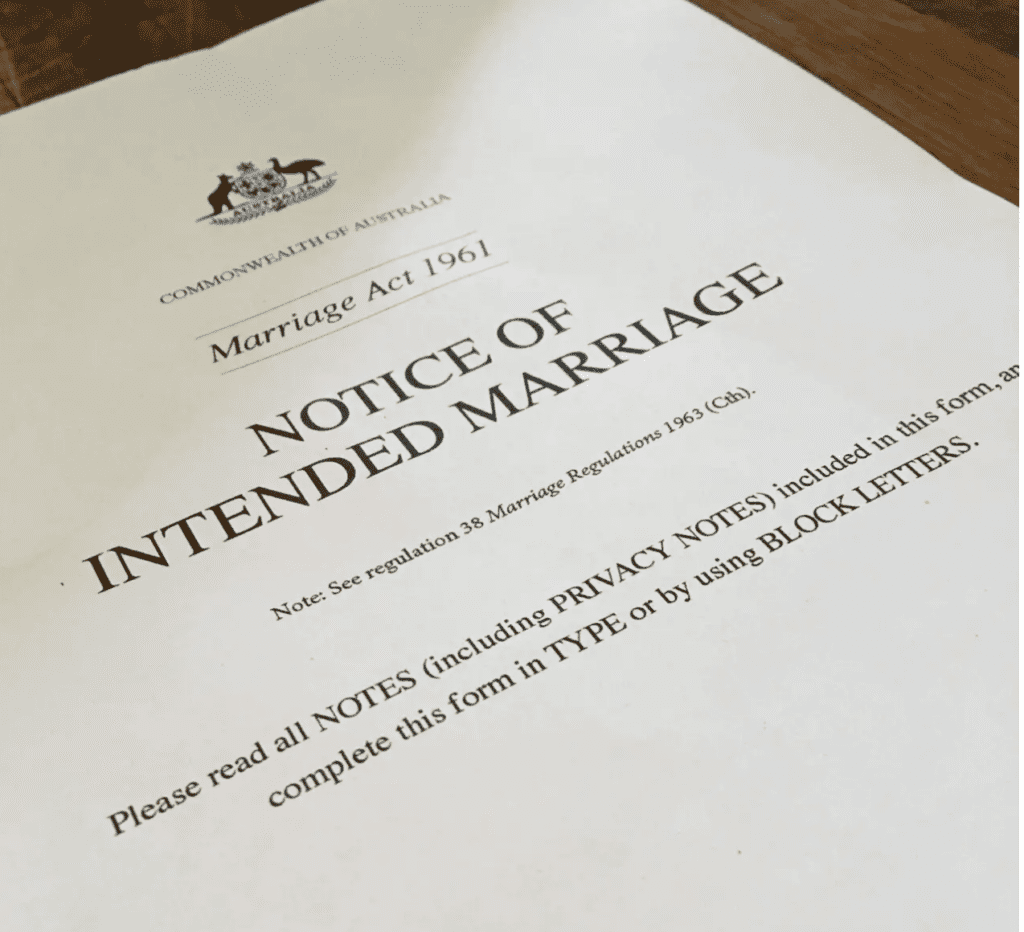
Use your full names, exactly as they appear on your Notice of Intended Marriage.
Your celebrant is also required to say a short statement called the monitum, which explains the legal nature of marriage in Australia. That one’s theirs to worry about, not yours.
How do the legal words and your own words fit together?
You say both. The usual order is the legal words first, then your personal vows immediately after — so the legal requirement is met, and then you get to say what you actually want to say.
On the day it runs like this: I introduce the vows, I feed you the legal words a line at a time and you repeat them, you read your personal vows from a card, then your partner does the same. Nothing to memorise.
There are four ways couples usually do this, and none of them is more correct than the others.
Legal words only
Short, dignified, done. A genuinely good choice, and always has been. Nobody in the audience will know or mind.
Legal words plus personal vows
You each write your own and read them aloud. The most common option by a distance.
Legal words plus promises you repeat after me
Personal content, but nothing to hold and nothing to memorise. Good if the reading-aloud part is what worries you.
Legal words plus vows you’ve written together
You write one set between you and both say it in turn. Lovely if you’d rather not write separately.
How long should wedding vows be?
About 150 words each, which is roughly one minute. Ninety seconds is plenty. Two minutes is the outer limit, and it will always feel longer out loud than it looks on the page.
This is the single most useful piece of advice I can give you, and the one couples resist most. Short vows aren’t less meaningful — they’re more. Every sentence that doesn’t earn its place dilutes the ones that do. If you have to cut, cut the general and keep the specific.
How do you actually start writing them?
Start by collecting rather than composing. Open a note in your phone and keep it open for a fortnight. Lines will arrive while you’re driving or falling asleep, and they’re almost always better than the ones you sit down and force.
When you’re ready to write, write badly and quickly. Get it all down — the too-much, the too-sentimental, the bits you’d never say out loud. You cut afterwards. Trying to write the final version straight out is what makes the blank page feel impossible.
Then apply three tests.
Is it specific?
‘You’re my best friend’ is true of most couples. ‘You are the person I want to tell things to first — the good news, the bad news, and the very boring news about the car’ is true of yours. Specific beats poetic every single time.
Does it sound like you?
If you don’t say ‘my beloved’ in real life, don’t say it at the altar. Vows written in a voice that isn’t yours sound performed, and everyone can hear it — including the person you’re marrying.
The best test I know: write it as though it’s a letter to them that nobody else will read, then take out only the things you’d genuinely be uncomfortable having your family hear. Usually that’s less than you’d think.
Can you actually keep the promise?
The good ones are the ones you can imagine keeping on an unremarkable Wednesday in eight years’ time.
Grand promises are fine and there should probably be one. But the promises that land are the ones with edges — to keep asking how their day was and actually listen to the answer, to always be the one who gets up in the cold.
What structure works for wedding vows?
If the blank page is the problem, borrow this skeleton and fill it in. No guest has ever noticed a structure.
- Open with them — one or two sentences. Something specific about who they are, or a moment you shared.
- Say what they’ve become to you — one or two sentences. What’s changed because of them.
- Promise — three or four sentences. One large promise, two or three small and specific ones.
- Close — one sentence. Short. One line that lands.
That’s about 150 words. That’s a minute. That’s a complete set of vows.
What should you leave out of your wedding vows?
- Inside jokes that need explaining. If it takes a sentence of setup, it belongs in the speech, not the vows.
- Anything at anyone else’s expense — an ex, a family member, a friend. It never lands the way you hope.
- A list of everything you’ve ever done together. Choose one thing.
- Promises you don’t mean. ‘I’ll never argue with you’ isn’t a vow, it’s a plan for an awkward anniversary.
- A borrowed paragraph from a film, song or poem. One line as a garnish is lovely. A quoted passage isn’t yours.
- Anything you can’t say without completely losing it. Keep one. Cut the rest.
What if you can’t get through them on the day?
You’ll probably cry. Most people do, and it’s fine — the room is entirely on your side.
A few things help. Slow down; nerves make everyone speed up, and speed is what makes voices break. Pause and breathe — a silence that feels endless to you is about two seconds to everyone else. Have a tissue on you, and don’t rely on your partner having one.
And if you truly can’t get through a line, hand the card to me. I’ll read it, and it will be just as moving.
Read them — don’t memorise them
Nobody expects you to recite. Memorising adds enormous pressure and gives you nothing, and if nerves take the words you’ve got nothing to fall back on.
Write them on a card or in a small book, in large type or clear handwriting. Hold it at chest height rather than up in front of your face — better for your voice, and better for the photos. Bring a spare copy and give it to me or someone in your wedding party; cards get left in cars and hotel rooms with alarming regularity.
Ask someone to record the audio
Couples tell me this constantly: the vows are the part you’ll most want to hear again, and the part most often missed because a microphone was pointed the wrong way.
Mention it to your photographer and whoever’s filming, in advance. It’s easily solved beforehand and impossible to fix afterwards.
Do you have to write vows at all?
No. Legal vows alone are completely valid, and a ceremony without personal vows can be every bit as moving as one with them. If the idea of speaking publicly fills you with dread, that’s a good enough reason on its own.
There’s no wrong answer here. There’s only the version that sounds like you.
Get the full guide
I’ve put everything above — plus writing prompts to work through, a structure you can fill in, and four complete example sets in four different tones — into a downloadable guide for couples.
It’s free, and yours whether I'm your celebrant or not.
Ready to Get Started?
I’m Shelley, a marriage celebrant based in Toowoomba, working across South West Queensland.
Helping couples find these words is genuinely the best part of my job - so if you get stuck, get in touch.
Vow-writing support is included in my Your Story package.
Get in touch:
Email: hello@theshelleybrant.com.au
Phone: 0458 748 969
Recent Posts